
Last updated
How fast can you deploy after an emergency?
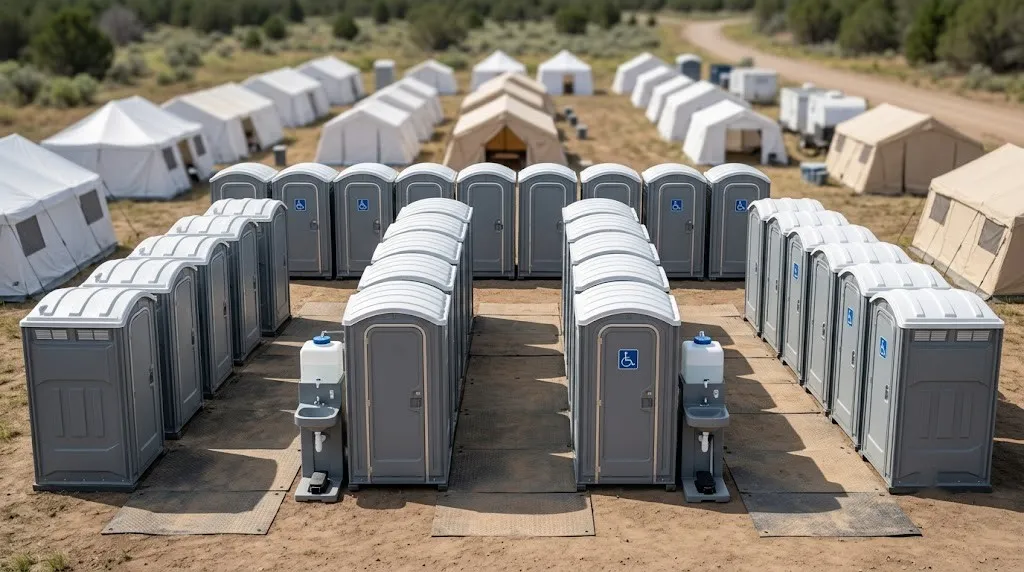
Emergency response is different from a scheduled event booking. We keep emergency porta potty rental units staged and ready, because disaster timelines do not wait for a normal delivery window. A crew clearing debris or a shelter standing up cots needs working sanitation before the first meal is served, not after. That is why our dispatch process for portable toilet rental during declared emergencies skips the standard quote-and-schedule sequence.
Once we know the headcount and site address, we size the order using the same logic as any large mobilization: OSHA 1926.51(c) sets 1 toilet for 20 workers or fewer on a construction-style crew, scaling up from there. Shelters and public gathering points follow a similar per-person planning approach, which we walk through on our how many porta potties do I need page. If the site has no power, we can pair units with a light tower rental or a temporary power pole so night operations do not stall. For water damage cleanup, a handwashing station rental or portable sink rental goes out alongside the toilets, since 29 CFR 1910.141(d)(2) requires soap and towels or a hand-drying device at any wash station, not sanitizer alone.
What does emergency sanitation cost during a disaster response?
Pricing during a disaster still runs on the same bands we quote for any short-notice job, though weekend and rush delivery fees apply if the request comes outside normal hours. A standard unit runs $100 to $350 a day depending on rush timing, and a weekend rate for a standard unit typically lands near $250. Full detail lives on our porta potty rental cost and porta potty rental per day pages.
| unit | day | week | month |
|---|---|---|---|
| standard | $100-$350 | $130-$500 | $125-$325 |
| ada | $200-$400 | $240-$400 | - |
| deluxe | $85-$1,200 | $150-$290 | - |
Delivery fees for rush or after-hours dispatch fall between $100 and $500 depending on distance and timing; a weekend delivery fee can run $125 to $540. If the response stretches past a few weeks, ask about our monthly porta potty rental rate instead of re-booking week to week, since a longer commitment costs less per day than a string of short ones. Storage for recovered belongings or equipment is available through storage container rental, and a 20ft storage container is often enough for a single displaced household's contents.
Do damaged septic systems need emergency pumping too?
Yes. Flooding and ground shifting are common causes of septic failure, and a compromised tank near Tempe needs pumping before it backs up into a structure. A typical residential tank holds around 1,000 gallons and is normally pumped every 3 to 5 years, but a flood-damaged or overwhelmed system needs attention immediately, not on that schedule. Our emergency septic service handles that call, and septic pumping service covers routine follow-up once the site stabilizes. If a restaurant or commercial kitchen in the disaster zone loses power to a grease interceptor, that unit needs pumping once fats, oils, grease and solids reach 25 percent of the liquid depth, covered under grease trap pumping.
Debris cleanup generates volume fast, and a roll-off dumpster rental clears it faster than repeated truck runs. A 20 yard dumpster rental handles most residential storm debris, while a 30 yard dumpster rental suits a commercial site. Know what is barred before loading it: check what cannot go in a dumpster before hazardous debris goes in the box. If the site needs to restrict access while cleanup continues, a temporary fence rental or chain link temporary fence keeps it secured overnight. For sites needing accessible facilities, ADA Standards section 213.2 requires at least 5 percent of clustered single-user units to be accessible, and never fewer than one; our ada accessible porta potty units meet the clear width and turning space specs described on ADA restroom requirements.
How many toilets does a shelter need?
It depends on occupancy, but OSHA 1926.51(c) offers a workable baseline: 1 toilet for every 20 people, scaling to 1 per 40 above that. A 100-person shelter needs several units plus at least one ADA unit under ADA Standards 213.2. Our how many porta potties do I need guide walks through the math.
Can you deliver to a site with no road access?
Not always by standard truck. A roll-off delivery needs about 60 feet of straight clearance behind the truck, and porta potty placement needs similar clear approach. Call us with site conditions; we will tell you what is possible before dispatch, and suggest alternate placement per our porta potty placement guide.
Do you serve areas outside Tempe during regional disasters?
Yes. We cover Guadalupe at 3.5 miles, Paradise Valley at 15.8 miles, and towns further out including Sun Lakes and Goodyear Village. Check service areas for the full list, or request routing through contact.
What if the disaster knocks out our water supply entirely?
OSHA 1926.51(a)(1) requires an adequate supply of potable water at any workplace, disaster or not. We pair toilet units with handwashing stations and can arrange potable water delivery; ask through request a quote with your headcount and site access details.
Will you work directly with a shelter or relief organization?
Yes, and we handle both the sanitation order and site logistics through one point of contact. Reach us through contact with the organization name, expected headcount and duration so we can size the order correctly the first time.
Next step
Get a delivery date
Tell us the address, the dates and the headcount. We size the order and confirm the route.